“Clear action on how to approach your investments in NVDA and other stocks:
This is something I mostly discuss with clients and we never disclose such information for free for multiple reasons ( Not everyone understands what this means and we discourage gambling. Nothing is ever financial advice. Everyone is responsible for their own actions. Paying for a product means you still own responsibility for your actions but you understand the level of complexity for the knowledge that you try to access to improve your knowledge and strategy).
For a limited time, I share part of this knowledge here, for no cost now. [...] Read more below.”
Hello everyone. Welcome to SAVE TIME. Save Time with YMagnify is for you if you care about the market but don’t have hours to waste. I break down futures, options and big geopolitical moves in plain language, so you understand what matters for price, fast.
Subscribe, read for a few minutes, walk away with a clearer plan. No drama, no buzzwords, just real context you can actually trade on. Let’s dive in.
At some point, valuation matters again.
A P/E north of 40 might look “fine” inside the AI mania, but remember the scale here. Nvidia is already huge, already hyper profitable, already the main winner in AI hardware.
To grow into this valuation, it has to keep compounding at an extraordinary rate, for an unusually long time, with no major slip.
History is not kind to that assumption. Think of Cisco during the dot-com boom: amazing company, real growth, real profits. But if you bought near the peak, you waited about two decades just to get back to even.
The business did well. The stock did not.
That is what happens when expectations run far ahead of reality.
Nvidia’s biggest strength is also a risk: the dependence on a tiny group of whales.
A handful of giant customers account for the majority of Nvidia’s revenue.
These are mainly the big cloud and AI players. They buy the chips, they build AI infrastructure, they hold Nvidia stock, and in some cases, Nvidia also invests in them.
That creates a loop:
Nvidia funds AI firms. AI firms use that capital to buy Nvidia chips. Nvidia books the revenue and reports huge growth.
The moment one piece of that loop slows, gets delayed or blows up, the numbers can shift much faster than a typical diversified business. When the same few entities control your demand, your stock is only as stable as their appetite and their funding.
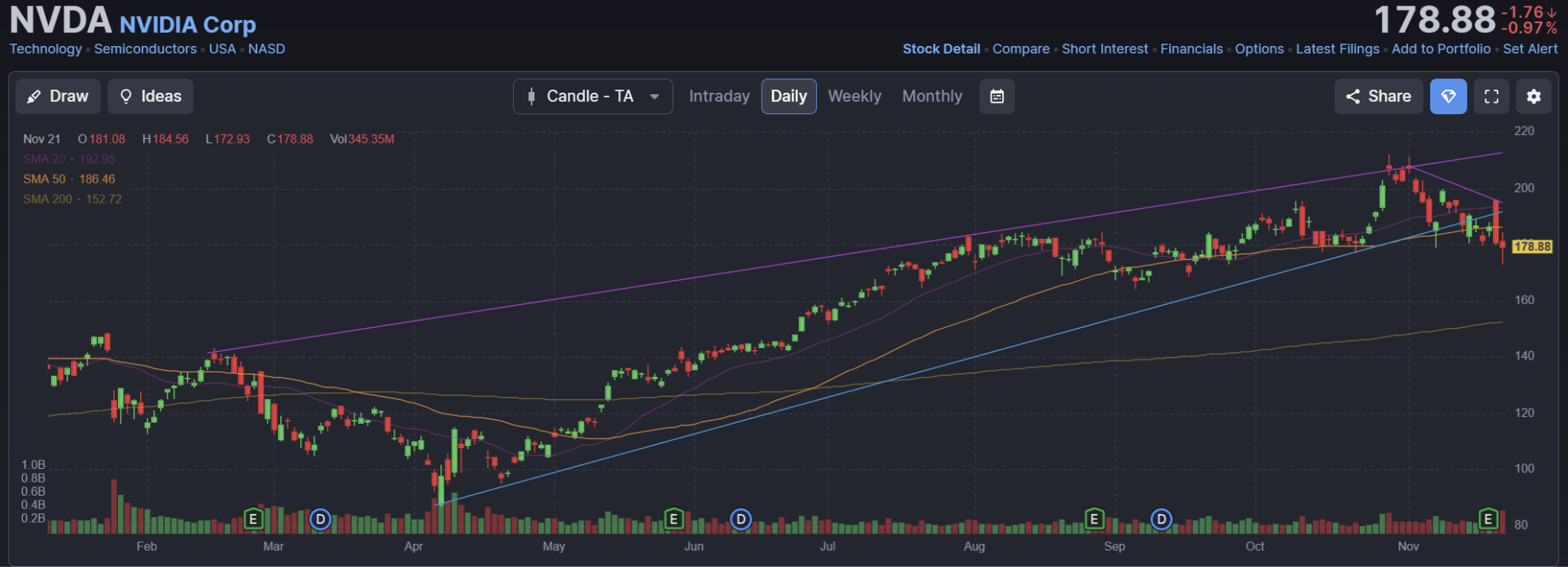
Graphic source: finviz
AI And Cloud Capex Will Not Go Up In A Straight Line Forever
Right now, the big tech players are in arms-race mode. They are pouring eye-watering sums into data centers and AI hardware.
But here is the key point as a trader: the market does not just care that spending is big. It cares about the direction of change.
The moment we move from: “Capex is exploding” to “Capex is still high, but the growth is flattening” THEN the narrative flips.
Many analysts, will start saying things like “peak AI capex”, “normalization”, “ROI scrutiny”, and so on. That alone can compress Nvidia’s multiple even if revenue is still strong.
The stock is priced as if the AI build-out will keep accelerating for years with no pause. That is not how cycles work.
Geopolitical Risk: The China Hit
The China story is no longer theoretical. It is already on the income statement.
US export restrictions on advanced AI chips have cut Nvidia’s China business hard and forced it to write down billions in unsold inventory aimed at that market. Guidance around China has gone from “big growth lever” to “assume nothing and hope policy does not get worse”.
At the same time, Chinese competitors like Huawei are racing to fill the gap with their own AI chips. Nvidia loses both revenue and strategic leverage in one of the most important tech markets on earth.
When a stock is already priced for excellence, adding geopolitical roulette on top is not exactly comforting.
Real Competition Is Finally Showing Up
For a while, Nvidia felt untouchable. Now, the moat is still wide, but no longer infinite.
You have:
• AMD pushing hard with its own AI chips • Intel trying to claw back relevance in accelerators • Google using its own TPUs in-house • Amazon deploying its hardware • Specialist players building radically different architectures for AI
None of these needs to destroy Nvidia. They just need to take enough share, or pressure pricing enough, that Nvidia’s growth and margins start to look a bit more normal and less divine.
The stock, however, is not priced for “normal”.
Clear action on how to approach your investments in NVDA and other stocks:
This is something I mostly discuss with clients and we never disclose such information for free for multiple reasons ( Not everyone understands what this means and that’s ok. Nothing is ever financial advice. Everyone is responsible for their own actions. Paying for a product means you still own responsibility for your actions but you understand the level of complexity for the knowledge that you try to access to improve your knowledge and strategy).
For a limited time, I share part of this knowledge here, for no cost now.
Here is how I would frame it as a trader or active investor.
Position sizing
Treat NVDA as a high-beta, crowded, emotionally charged name.
A 20–40 % drawdown from current levels would be completely normal in this type of regime. You do not size a stock like this the same way you size a boring index fund.
Risk signals to watch
• Any slowdown in capex or AI enthusiasm from the big cloud names • Any new restrictions, tariffs or tensions affecting US–China tech flows • Increasing mentions of “AI spend optimization” or “ROI discipline” on earnings calls
Hedging ideas
If you already sit on a big NVDA position, you can look at:
• Protective puts around key events like earnings • Collars to cap upside but protect the downside • Balancing your book with index or sector hedges instead of selling everything into strength
The goal is simple: stay in the game if you believe in the long-term AI story, but do not let a short-term air pocket blow up your equity curve.
Mindset
Do not trade Nvidia as a fan. Trade it as a risk asset that happens to be at the center of AI.
When the story feels “inevitable”, that is when you should be most careful.
As a conclusion
Nvidia is not a scam. It is one of the most important companies in the world right now. But that does not mean the stock is safe at any price.
Short term, the setup is clear: Extremely high expectations, concentrated customers, political risk, rising competition and a market that has already rewarded the story with a multi-trillion dollar valuation.
That is exactly the kind of environment where sharp, ugly corrections happen.
If you manage your size, protect your downside and stay honest about the risks, you can still participate in the AI story without becoming its casualty.
You’ve got the picture now – what moves the market and why, in minutes, not hours.
If this helped you think clearer or trade calmer, hit subscribe so you don’t miss the next breakdown. Share it with that one friend who’s always “checking the charts” but never has time to read the news.
Save time, stay prepared, and let YMagnify do the heavy lifting while you focus on execution. Skip the intros. Get the knowledge.
Appreciate your breakdown and sharing your view. This brought fresh views. Over concentration is a risk especially when there is so much expectation. This has brought over valuation, something that we can't change as there are not many other companies that look well poised for the future - where the magnificent 7 is leading the pack. With unemployment & affordability, the government has much work to be done. Debt is a rising concern with increasing delinquency and we would "discover" more swimming "naked" when the tide is out. The recent week has brought some margin calls and let's monitor.



Appreciate your breakdown and sharing your view. This brought fresh views. Over concentration is a risk especially when there is so much expectation. This has brought over valuation, something that we can't change as there are not many other companies that look well poised for the future - where the magnificent 7 is leading the pack. With unemployment & affordability, the government has much work to be done. Debt is a rising concern with increasing delinquency and we would "discover" more swimming "naked" when the tide is out. The recent week has brought some margin calls and let's monitor.
Good article. Thank you