
UPDATE: Iran's Vacuum. The Cold Economic Shockwave and HOW to navigate the current markets.
Charts and Technical Analysis Included. This new conflict changes our lives every day. Your position in this economy and the markets matters now more than ever. See more below.

Welcome to Save Time with YMagnify.com.
The publication that simplifies complex headlines and financial data, so that you can Save Time and focus on making the best decisions for your trades and investments.
Online noise, screaming headlines, useless panic - they are all meant to play with our mind and to affect the decisional process. Don’t let that get to you.
Understand just what matters from all that noise. Everything is presented in an impartial, simplified way. It’s made by a real certified economist and market analyst for busy people everywhere. Educational purpose. Check disclaimers.
Subscribe to this publication for simplified complex knowledge.
Let’s dive in.
Updates below

Reports confirm Israel conducted targeted airstrikes on Tehran’s outskirts overnight, killing Ali Larijani, secretary of Iran’s Supreme National Security Council and key figure since Supreme Leader Ali Khamenei’s death last month.
Iran responded March 18 with IRGC missiles carrying cluster warheads striking central Israel, resulting in two civilian deaths near Tel Aviv. Additional drones targeted a U.S. embassy in Baghdad and an Australian base in the UAE. Iran’s new Supreme Leader Mojtaba Khamenei stated the perpetrators would “soon pay,” while army chief Amir Hatami warned of a “decisive and regrettable” reply.
This marks the tenth senior official lost since late February strikes began.
From a trader’s screen, this sequence registers as maximum uncertainty: a power structure disrupted at conflict’s peak, with retaliation cycles now accelerating.
Current Market State: Stagnation Amid Commodity Strain
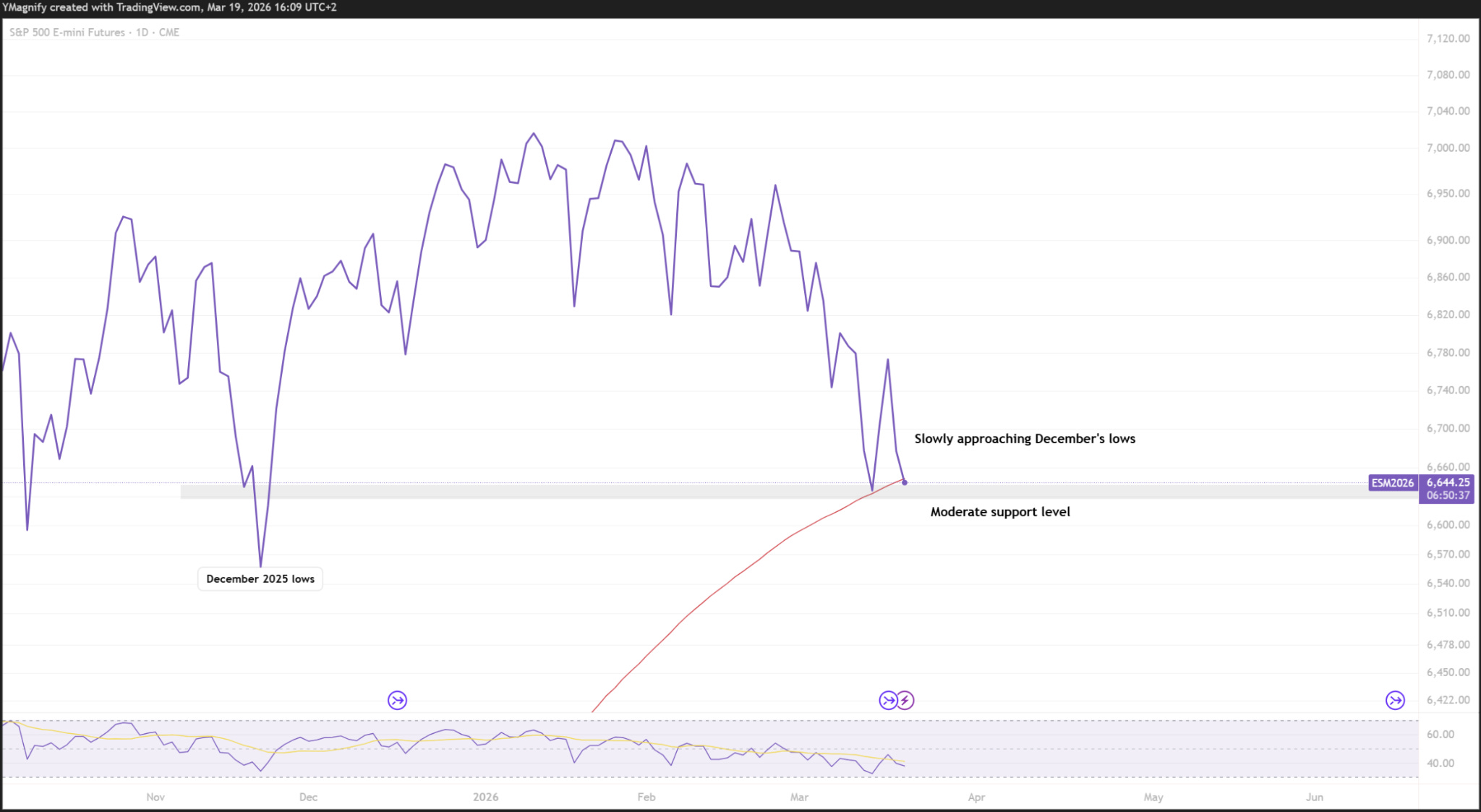
So let me make a short summary with what’s happening right now in the market, at the moment I am writing this - and how to interpret these changes for better future positioning.
ES Mar ‘26 futures hover in a narrow 6,650-6,680 range following a 0.8% decline yesterday, showing premarket flatness with subdued volume.
The VIX has risen since last week, reflecting elevated but contained volatility expectations.
NQ futures trade 1.1% lower premarket, pressured by the Nasdaq-100’s -0.72 year-to-date correlation with oil prices, which amplifies energy cost impacts on tech margins.
The 10-year Treasury yield has edged, steepening the yield curve and tightening financial conditions independently of policy shifts.
The Fed’s March meeting maintained rates at 3.50-3.75%, noting “geopolitical energy uncertainty” as a factor delaying cuts. Market pricing for June relief has evaporated.
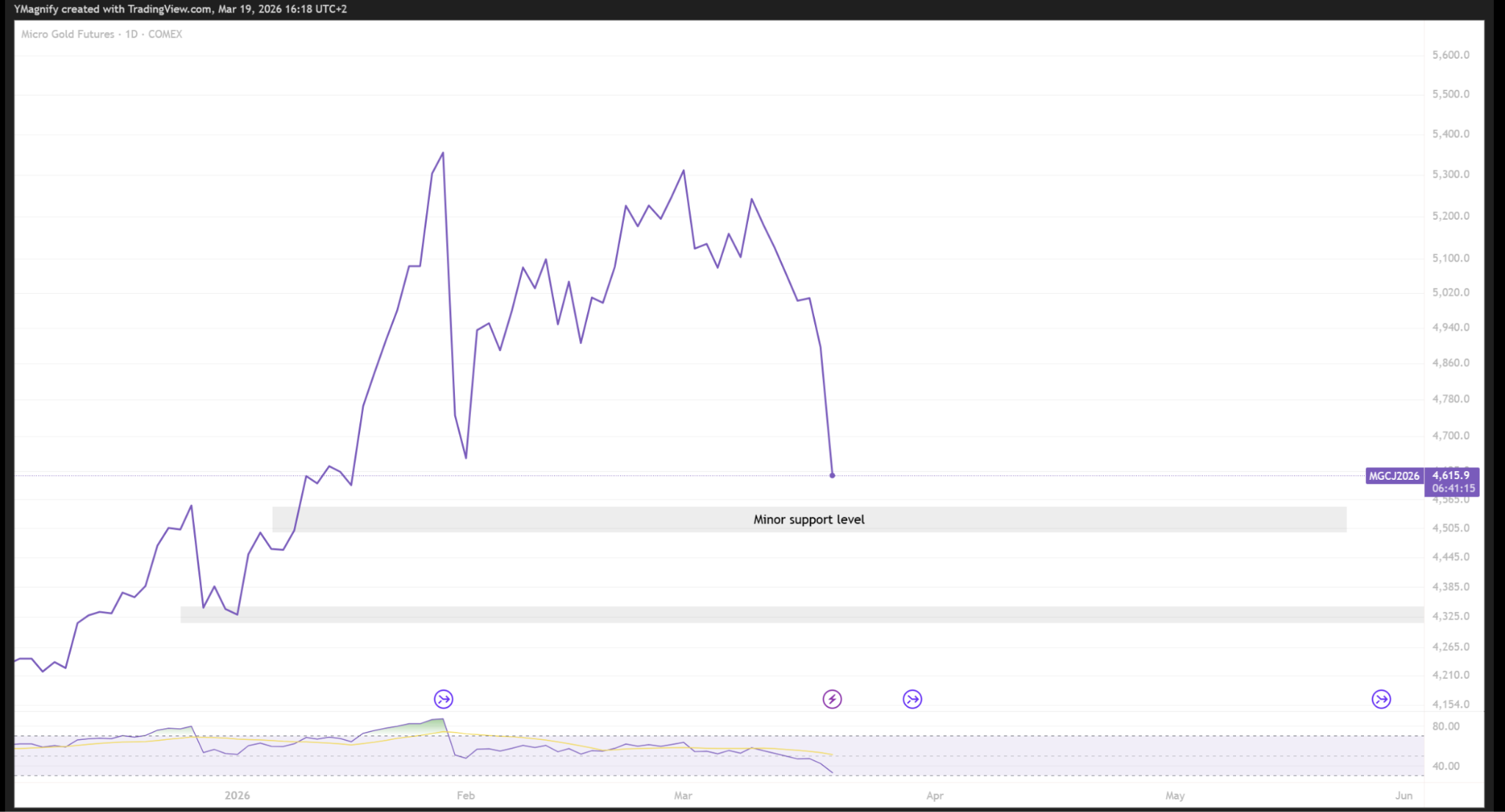
Commodities reflect the strain: gold holds near $4,850/oz, currently being in a correctie phase around the ~$4,600/oz area, sustained by institutional safe-haven demand from entities like China and India.
WTI crude has advanced to $98/bbl, breaking a 97-99 consolidation pattern, with geopolitical risk premia now comprising approximately 40% of its valuation (doubled from 5% pre-escalation). I talked about oil in more technical detail here
Economic Transmission: Supply Shock Mechanics
Quantified impacts follow standard supply shock pathways: a $10/bbl WTI increase equates to roughly $0.40/gallon at U.S. pumps, contributing 0.6-0.9% to core CPI via transportation and services pass-through.
Escalation involving the Strait of Hormuz (20% of global oil supply) could amplify this to 1.2-1.5%.
The Fed faces a dual-mandate constraint: easing amid rising inflation risks political exposure pre-midterms, leading to sustained yields at 4.4-4.5% and equity P/E compression from current 22x levels.
Historical precedent
The Iranian Revolution in 1979 saw oil triple, CPI reach 13.5%, and Fed funds peak at 20%.
Modern differences include energy’s reduced 4% U.S. GDP share (vs. 10% then), but higher system leverage accelerates transmission: high-yield spreads widen 50bps rapidly, credit availability contracts, and recession probability rises to 45% if WTI sustains above $105 into Q2.
Probabilistic Scenarios*: Objective Risk Framework
Scenario 1 (60% probability): Prolonged low-intensity exchanges over 2-4 weeks, avoiding full Hormuz closure but sustaining proxy interference.
WTI reaches $105-110/bbl, adding 0.6% to CPI. ES/NQ decline to 6,400/22,000 (8% drawdown), yields to 4.4%.
Positioning*: resist ES advances above 6,680 targeting 6,500.
Scenario 2 (25% probability): Strait disruption via mining or blockades (post-Israeli escalation, e.g., Natanz).
WTI exceeds $130/bbl, CPI +1.5%, equities -15-20%, VIX to 35. Positioning*: crude futures (CLZ26), volatility straddles.
Scenario 3 (15% probability): Internal instability exploits the vacuum, leading to supply normalization.
WTI falls to $85/bbl, enabling ES recovery to 6,900.
Positioning*: equity longs below 6,600, energy puts.
These derive from historical conflict pricing and current order flows, not sentiment. These reflect my personal outlook and analysis at the moment of writing.
Key Near-Term Possible Catalysts
Israeli response by session end could accelerate commodity pricing.
Friday non-farm payrolls below 150k with revisions signal yield pressure.
Following CPI (projected 3.4% core y/y) quantifies energy effects.
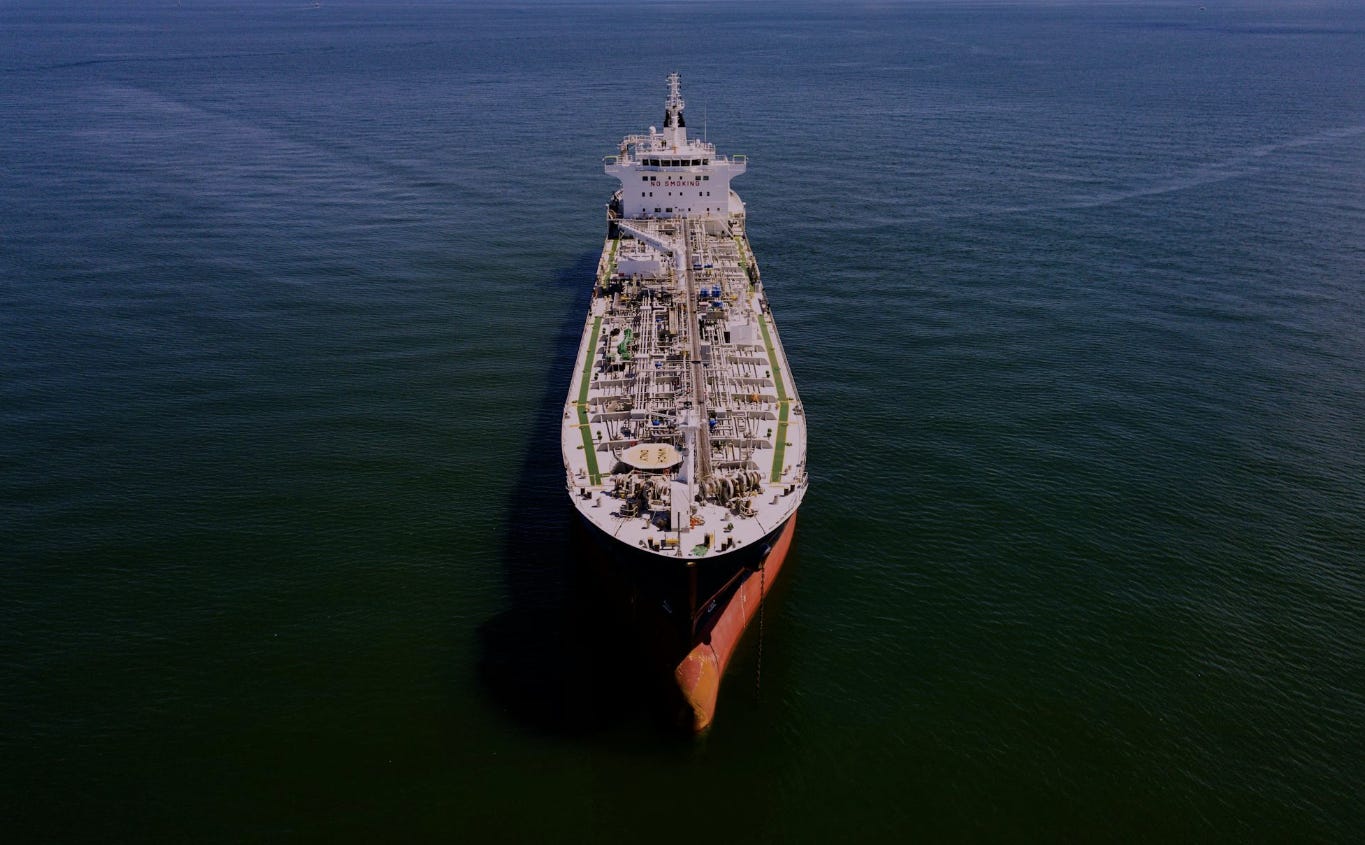
Monitor Hormuz tanker volumes and IRGC activity indicators.
Market Dynamics in Vacuum Conditions
Let me simplify this even more:
Sometimes the market doesn’t move because things are getting better. It moves because something stops working.
That’s what power disruptions really do.
They slow production, tighten supply, and make essential resources like oil, gas, and metals more expensive. Not because demand is exploding, but because supply becomes uncertain.
And when supply is uncertain, price gets a “risk premium” added to it.
At the same time, this puts pressure on stocks. Companies face higher costs and less visibility, so markets struggle to move higher unless there is support from governments or central banks.
Because of this, traders shift their mindset.
It’s no longer about simply guessing if the market goes up or down. It’s about understanding what happens if something breaks again. Supply shocks tend to create fast, aggressive moves, especially in commodities. So the focus moves away from direction and toward imbalance.
This becomes a market driven by reactions, not smooth trends.
And in this kind of environment, the edge is not about predicting perfectly.
It’s about staying aware and being ready when things suddenly change.
Thanks for reading. If this motivates you or if this is a harsh truth that brings you discomfort but determination, then you are in the right place.
See you soon. Stay focused. Subscribe to this publication.
Stay prepared. We grow together,
Yuna, YMagnify.com
Website: https://ymagnify.com
X / Twitter: https://x.com/ymagnifycom
Substack: https://substack.com/ymagnifycom
Spotify PODCAST: Rushing Simplified News for Busy Investors
YouTube: YMagnify’s official YouTube
*Disclaimer: This content is for educational and informational purposes only. It is not financial, investment, tax, or legal advice. Markets involve risk, and you are solely responsible for your decisions. Always do your own research and decisions before acting.
🔴Everyone posts headlines, but what do they mean?
Daily macro clarity you can act on.
🔴I'm dissecting Iran's leadership vacuum after Larijani's death: oil current price, ES/NQ frozen, yields climbing, gold correcting.
🔴I deliver the cold econ math (0.6% CPI spike), my 3 scenarios with technical levels and precise trade plans for ES shorts/WTI longs.*
🔴I think we should all get positioned, not surprised, at the cost of our money.
#Markets #IranWar #OilTrading #GOLDSignals